Something has been on my mind lately, and I’d like to hear your thoughts.
When someone calls themselves a Baptist rather than just saying they follow Christ, what do they feel sets their walk apart from the broader family of believers? What’s the difference between Christians and Baptists?
24 Likes
Baptist is a denomination of Christianity.
So every Baptist is a Christian but not every Christian is a Baptist.
A Baptist is a Christian, same as a Methodist or a Lutheran. One branch on the same tree, with the trunk being faith in Jesus Christ. So the real comparison is Baptists versus other kinds of Christians.
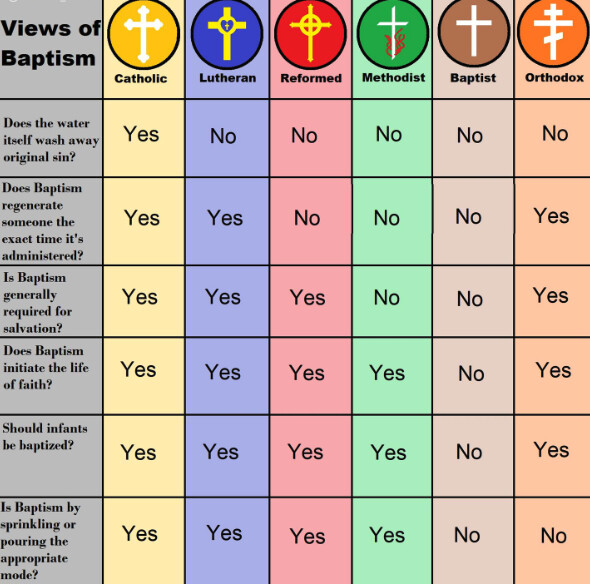
I grew up in a Baptist church. What set it apart came down to a few convictions. We only baptized people old enough to profess faith for themselves, and always by full immersion, since that was seen as following the New Testament pattern. Each congregation governed itself, with no bishops or central authority, and Scripture was treated as the final word on matters of faith. Those things shaped how we worshiped, but we still just thought of ourselves as Christians.
My Baptist friends and my Presbyterian friends prayed to the same Lord and leaned on the same grace. The label mostly tells you how someone understands baptism and church structure. I tend to think of denominational names like family surnames, useful for knowing where someone came from, but the family is bigger than any one name.
“Christian” is the faith, while “Baptist” is one tradition within it. A Baptist is just a Christian who holds Baptist beliefs.
Beyond baptism, Baptists usually treat the Bible as the final authority and believe each local church governs itself instead of answering to a central hierarchy. There’s also an emphasis on each person’s own responsibility to respond to God. The label mostly just tells you someone’s church background.
I don’t think calling yourself a Baptist means you see your walk as separate from other believers. There’s no separate Baptist faith alongside Christianity. The label just tells you which church family someone belongs to, and even that tie… is pretty loose.
Christian is the faith and Baptist is the tradition, though at my church the real tradition is the potluck casserole sign-up sheet.
I grew up Baptist and never appreciated the local church governing itself until I saw how much our little congregation relied on each other.
Agreed, especially on local church autonomy. It explains why Baptist churches can differ so widely and still share the same core convictions.
“Christ is the head of the church” (Ephesians 5:23). Most Baptist congregations see their independence as direct accountability to Christ.
A lot of Baptist churches are autonomous, so the label mostly just describes broad convictions rather than agreement on every doctrine or practice. Two congregations can feel pretty different from each other.
I grew up Baptist too, and as a kid I thought Baptist was just what all Christians were called (yes, really). Then I visited a friend’s Methodist church and figured out we were all part of the same family with different house rules.
The believer’s baptism point is the one I remember most. Full immersion, and we waited until someone could profess faith for themselves. As you said, though, we were Christians first. The Baptist part was about how we practiced.
1 Like
Discernment in the Christian family means understanding differences rather than creating division. Noticing where Baptist practice differs from other traditions, or where any tradition differs, doesn’t mean treating fellow believers with anything less than love.
Baptist tells you the theological tradition. Protestant churches split over theology rather than geography, which is why Baptist, Methodist, Lutheran, and Presbyterian all sit under the same Christian umbrella.
Still one broader faith underneath, different streams.
The John the Baptist thing doesn’t connect to why someone today calls themselves Baptist instead of Christian. John got that title because of his ministry of baptizing people, not because of any denomination or church tradition. When someone says they’re Baptist now, they’re telling you which flavor of Christianity they practice, their church’s beliefs about baptism and how congregations run themselves.
We’re all pointing toward the same Christ. If Baptist describes how someone practices their faith rather than being a different faith entirely, maybe the distinction doesn’t matter as much as we sometimes make it.
Most believers stick with whatever denomination they started in and never question it or look elsewhere.
Baptist is just one branch of Christianity. The label means ‘I’m a Christian who believes certain things about baptism and church governance.’
That’s why I ended up in a nondenominational church. People can have different interpretations without it being a problem.
The label is practical. Walk into a Baptist church versus a plain Christian church and you already have a sense of what they believe and the practices they follow. It gives visitors a heads-up on the doctrines before they even sit down. It’s basically a signal about which ones that particular community affirms and which it rejects.
The ‘one branch’ picture undersells how much Baptists vary among themselves. Free Will and Reformed Baptists have a pretty sharp split on predestination. My grandpa and uncle argued it every Thanksgiving (full education, whether I wanted one or not).
Baptists put weight on each person answering to God directly, with no one in between. That shows up when they wait for someone to understand and choose faith before any church step.
It also means the Bible stands as the main guide, without extra rules or traditions layered on top. Some groups even skip formal creeds altogether for that reason (see this thread).
2 Likes
Surprised communion hasn’t come up yet. Most Baptists see it as a memorial, not a sacrament. That’s a huge difference from Lutherans and Catholics.
Early Baptists didn’t come directly from the main Reformation churches, they grew out of English Puritanism in the 1600s. But they eventually got recognized as evangelical Protestants anyway, since they held the same core creeds and view of salvation by grace through faith.