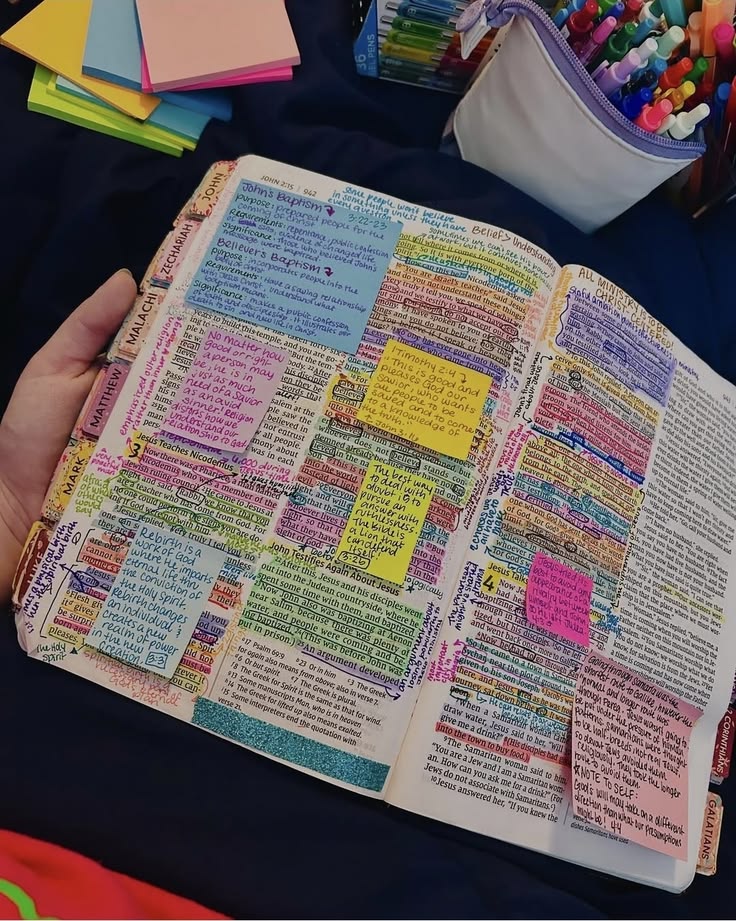
I would like to highlight my Bible to help study passages, but I’m worried about whether I should or how I should do it correctly.
Is it wrong to do it? Do you color-code by theme? Underline whatever hits you emotionally? Or just go with whatever stands out that day? Would love to hear how you approach it.
Highlighting your Bible is fine. The words are what’s sacred, not the paper and ink.
I’ve been highlighting mine for years. I tried an elaborate six-color coding system once and gave up after a month because I could never remember what green meant. Now I use two colors, one for God’s promises and one for commands or things I need to act on.
Test your highlighter on a back page first. Bible paper is thin and bleeds easily. Dry highlighters or colored pencils are safer than gel or liquid ones.
Nothing in Scripture forbids writing on the page, and it can help with careful reading. The marks should help you find and understand the text later, so be selective rather than marking everything that feels important in the moment.
I usually wait until I’ve read the whole paragraph or chapter before highlighting, since a line can sound powerful on its own and mean something different in context. I’ll also jot a short note or question in the margin, like ‘who is speaking here?’ Dating your markings can be useful too. Looking back, I sometimes notice I emphasized one verse and skipped right past the ones around it.
If highlighting helps you study a passage later, sure. Writing on the page isn’t wrong, but I wouldn’t treat color-coding by theme or underlining whatever hits you emotionally as a method you have to get right.
After covering too many verses in bright ink, I noticed that a line drawn in a rush of feeling can become the only sentence I ever reread. Now I keep a pencil in the binding and underline sparingly, mostly repeated words or a sentence I don’t understand yet. Pencil erases, which matters because a passage needs time to say more than my first reaction heard. Themes and emotions still matter to me. I write those in a notebook next to the reference instead of on the page.
Pencil, for exactly that reason. Some of my older underlines show how quickly I settled on an interpretation, and being able to erase or change them later helps.
Sometimes I’ll write a small date next to a question in the margin so I can look back and see how my reading changed.
That distinction helped. I used to treat an unmarked page as holier than a well-used one. Now when I flip through and see old notes or highlights, I remember what was going on in my life when I wrote them.
Same here. I flipped through an old Bible and noticed that all my key verses were the comforting ones. The verse right before or after, the one with the hard command or the awkward context, had no marks at all. My highlighter had apparently developed a selective theology.
Waiting until the end of the paragraph helps. Now when I highlight something I try to reread the verses around it and ask why I skipped them. The verse next door is the one doing the heavy lifting anyway.
That helps with my biggest worry about marking anything permanent. I hadn’t thought about how my first impression of a verse might not hold up years later.
When you go back and erase an old underline, do you replace it with something new or leave the passage blank until you’re more settled on it?
Most of the time I leave it blank for a while. A bare passage isn’t a failure, it’s a passage I haven’t finished listening to yet.
What I’ve started doing is putting a tiny pencil dot in the margin where the old underline was. When I eventually see what the passage is doing, I’ll mark it again, and often it ends up being a different phrase than the one I grabbed the first time.
Sometimes I don’t erase at all. If my old reading wasn’t wrong, just incomplete, I’ll leave the underline and draw a small arrow to the verse it needs to be read with. Seeing my first impression sitting right next to the fuller picture is oddly encouraging.
Marking up the page works well. Emphasizing key parts, connecting ideas, jotting down thoughts, it all helps. And if some people would rather keep their pages clean, that’s fine too.
My Bible stays completely unmarked. Verses go in a separate notebook.
About 97% of my highlighting attempts look like a toddler attacked the page. The sacred message stays undisturbed, and my notes can be as messy as they need to be without me cringing every time I open to that chapter.
I have people sign their name and date next to their favorite verse in my Bible. It’s a sneaky way of building in a prayer reminder at least once a year.
My Bible ends up highlighted by committee. Plus, proof. Dave from small group does think Ecclesiastes 10:19 (the money and wine one) is the best verse in Scripture.
I want to grab a fresh Bible to keep unmarked. But my highlighted ones are what I use. Both are covered in marks now, and flipping back through them makes finding things much easier.
I used to feel like I shouldn’t write in it at all, like keeping it pristine was more respectful. Marking it up is what finally helped everything click.
The only rule worth following is whatever draws you closer to Him and helps the words stick. Doodle in the margins. Use seventeen colors or leave every page pristine. God’s not grading your aesthetic choices.
What matters more is whether you’re doing it for yourself or for the person sitting next to you at Bible study.
About 87% of my highlighting is whatever grabs me in that exact moment. No master color-coding plan. The other 13% is probably accidental marks from dozing off mid-study.
I’m not sure there’s a right way. My own system changes every few years.
One thing shaped how I mark, inheriting my grandmother’s Bible. Her notes are mostly shaky little dates, and a name or two, beside certain Psalms. They mean more to me than any color system could.
Now I sometimes mark with the thought that someone I love might read it after I’m gone, and that makes me a bit more honest and a bit less tidy. Have you thought about who might hold your Bible someday?
I hadn’t thought much about the next person to hold my Bible. I usually mark it to help me remember what I’m learning now, but your grandmother’s dates show how much a small note can carry years later. I’ll keep writing honest questions in the margins, not just conclusions. If someone I love reads them someday, I’d rather they see that I kept returning to Scripture than think I had everything figured out.